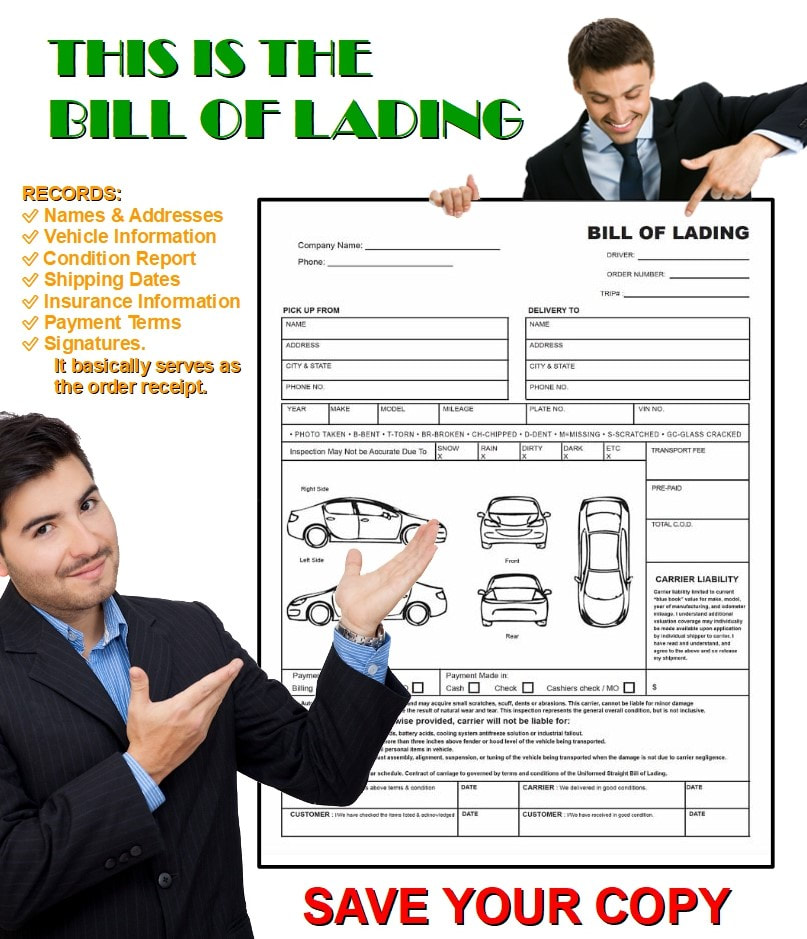
Bill of Lading in Auto Transport
Learn about How the Bill of Lading (BOL) Works in Auto Transport.
|
Page Contents: Bill of Lading Guide
FMCSA Regulation: 49 CFR 373
FMCSA regulations (49 CFR 373) require motor carriers to issue a,Bill of Lading (BOL) for all property, serving as a receipt and contract. It must include carrier/shipper names, DOT numbers, addresses, cargo description, weights, payment terms, and agreed pickup/delivery dates.
|
What Is a Bill of Lading (BOL) in Auto Transport?
The Bill of Lading is a legally binding document issued by the carrier at pickup and finalized at delivery.
🧐 What the Bill of Lading Does in Auto Transport
The Bill of Lading (BOL) is the most important document used during vehicle shipping. It acts as a transport contract, a vehicle inspection report, and a pickup and delivery receipt all in one.
If you arrived here from our Glossary, the short definition is simple:
A Bill of Lading is the document that records your vehicle’s condition at pickup and delivery and serves as the official contract between the shipper and the carrier.
Below, we’ll explain exactly how the BOL works, what information it contains, and why reviewing it carefully before signing can help protect you if a damage claim or dispute arises.
The Bill of Lading Serves Three Critical Purposes
The Bill of Lading functions as [1]:
✅ A contract between the shipper (customer) and the carrier (auto transport company).
✅ A receipt confirming the pickup and delivery of the vehicle.
✅ A condition report used to assess any damages that may occur during transport.
💡 The BOL is an important document in auto transport, and reviewing it carefully before signing is crucial. [2]
✅ A contract between the shipper (customer) and the carrier (auto transport company).
✅ A receipt confirming the pickup and delivery of the vehicle.
✅ A condition report used to assess any damages that may occur during transport.
💡 The BOL is an important document in auto transport, and reviewing it carefully before signing is crucial. [2]
📝 Why the Bill of Lading Is Critical for Vehicle Shipping
This single document is the primary record used to document a vehicle’s condition before and after transport and plays a critical role if a damage claim or dispute arises.
Proof of Vehicle Condition at Pickup and Delivery
The Bill of Lading documents all visible damage at pickup and establishes the vehicle’s baseline condition. At delivery, the same document is used to confirm whether the vehicle arrived in the same condition. Any discrepancies must be noted before signing.
Required Documentation for Auto Transport Damage Claims
The Bill of Lading is required when filing an auto transport damage claim. Claim decisions are based heavily on what is documented on the pickup and delivery inspections. If damage is not properly recorded on the BOL, claims may be delayed or denied.
Prevents Disputes Between Shipper and Carrier
By clearly documenting vehicle condition, dates, and agreed terms, the Bill of Lading helps prevent misunderstandings and disputes between the customer and the carrier.
Bill of Lading at Pickup vs Delivery
The BOL outlines the agreed terms of transport and records the condition of the vehicle at both points.
🟢 Pickup Inspection: Establishing the Vehicle’s Baseline Condition
At pickup, the carrier performs a visual inspection of the vehicle and records any pre-existing damage on the Bill of Lading. Customers should review this inspection carefully, compare it to their own photos, and ensure all visible damage is accurately noted before signing.
🟠 Delivery Inspection: Confirming Final Vehicle Condition
At delivery, the vehicle is inspected again using the original Bill of Lading as a reference. Any new damage must be documented on the delivery portion of the BOL before signing. Signing without notation may affect eligibility for a damage claim.